The causal loop diagrams in this post have been heavily inspired by GeePawHill (also known as American Mike Hill) ‘s How TDD and Pairing increase production. These diagrams were meant to follow mikes’ story. After they were done, another order presented itself. I recommend you read Mike’s post for some background and an interesting comment thread after you’ve seen the diagrams. I’ll use Mike’s definition of internal quality for this post, and refer to it mostly as ‘quality’.
Zed and Carry are programming an online catalogue for Amazing Widgets. If they deliver new features for the catalogue faster, their company will make more money, because they can outsmart the competition and draw more paying users to their site. Sure, they have a customer, but he’s on holiday at the moment; he might return for another post  . Right now Zed and Carry are chugging through a long list of feature requests the customer left them, so they would not be bored while he was away…
So far they have not made much progress. Carry and Zed are wondering why they are going so slow. Carry read this post by GeePawHill saying “the biggest single determinant in today’s production is the quality of yesterday’s production.”

yesterdays quality is the single biggest determinant of todays' quality
That sounds mysterious. Carry wonders how to write good code today, if everything has already been determined yesterday… It seems kind of hopeless! She was taught in school that the number of lines of code a programmer wrote in a day was a measure of productivity. Now she was wading through file after file, looking for the one line she needed to change. If only the code were smaller, the variable names were not all spelled like I, J and cmd and that whenever she was debugging she would not need to remember over 15 classes at once… All of the decisions they took in a hurry to get the new features in production before the customer went on holiday were now haunting them like the ghost of christmas past…
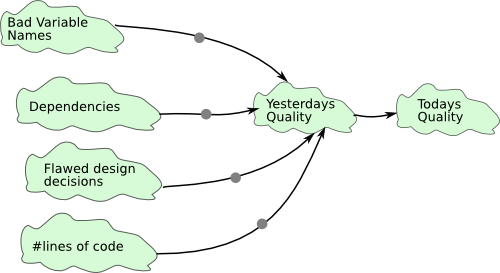
What determines yesterdays' quality: bad variable names, many dependencies, flawed design decisions and the number of lines of code
They stare at each other for a moment. Zed says “what if today’s internal quality was better?”. What would our code like, and what would it mean for us? Carry dreams away. ” If today’s code were better, we would have less dependencies and much less code, and everything was so clearly named that I knew where to start working immediately. But I don’t know where to start refactoring! It’s all tangled together, I don’t understand what half the code is doing, it just sounds like a dream. And I don’t have time to work on that dream, because we have to hurry! The customer will return from holiday soon, we need to show some progress. Hmm, Zed goes. I think if we stared naming the variables better in the bit we’re working on now, we could see some improvements soon, it would make our work for this afternoon and tomorrow already a bit easier. With the refactoring tools we have it’s not dangerous at all, and we can always get the previous revision from version control if necessary. We could spend part of our increased speed tomorrow on some other improvement.
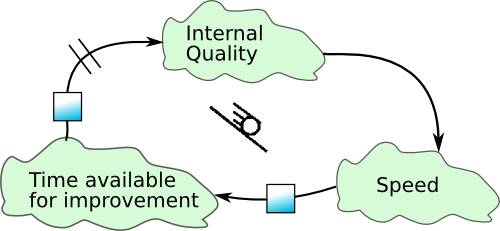
If internal quality goes up, speed will increase. This can free up time to improve (but you have to make a conscious choice, hence the decision square). With time available for improvement, internal quality can improve, given you choose relevant improvements and have agreed what improved internal quality means. The 'condensator' symbol indicates there may be a delay. Try to choose improvements that improve internal quality quickly - that helps motivate further improvements. If this works you will get a snowball effect: you will go faster and faster, while delivering ever better quality software.
“That would be great”, says Carry “I’d really like that. But I’m scared to break features that are already working. With all these dependencies I don’t know what might fall over when I refactor. Remember the trouble we had with the helpdesk after our last release? Hmmm… Would you be willing to help me clean up the design in the part I’m working on?”
“Sure”, says Zed, “Why not, I can’t go any slower than I am now, and maybe together we can come up with a way to add some tests as well. I’ve been aching to write some of these microtests, I’ve done some exercises but I just can’t figure out where to start. I’ve heard that it can help you focus on the design as well, and the refactorings would be a lot safer – Come to think of it, I still don’t fully trust our refactoring tool, it seems a bit wonky at times; some refactoring up front would make it easier to add tests, so having your help to refactor would be great, it would be a lot safer that way”.
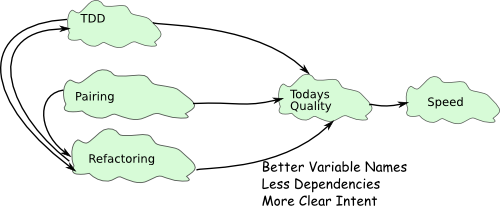
Test Driven Development, Pair Programminging and Refactoring improve today's quality, so that we can go faster later today or tomorrow. Pairing supports refactoring, Refactoring supports Test Driven Development and vice versa. This leads, amongst other things, to Better Variable Names, Less Dependencies and code that expresses its intent more clearly. Pairing and TDD also help prevent and eliminate defects, but that is a subject for another story.
Carry and Zed sat together, changed some names, did a few commits and eventually found a place where they could start writing a test. To their surprise, adding a few more tests was easy, and they were surprised at how little time it took to actually do these things. Carry had some time left at the end of the afternoon to continue reading GeePawHill’s post:
“If you want to increase the productivity of your team, then do these three things:
- write a microtest that fails before you change any code;
- adopt a “no-pair no-keep” agreement;
- establish a shared understanding of internal quality.”
Zed was happy they did this as well. Tomorrow, they could go even faster! He was almost thinking of working alone again tomorrow and skipping the tests, but thought again. He wanted to go at least as fast the day after tomorrow…
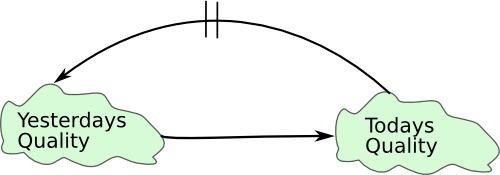
Tomorrow, today will be yesterday. Any improvement we can make today, however small, will help us go faster tomorrow.
After thought
For a long time I’ve been planning to illustrate the value of test driven development through diagrams of effect here. We’ve been using this to ‘sell’ the benefits of TDD to course participants and folks we mentor for a few years now, and it’s been remarkably effective. The essence is simple, as Marc Evers put it:
“If we work on the same code as you today, and we write tests and pair when you don’t, We’ll be drinking beer in the bar, while you’re still inside fixing bugs”
Well, that’s the benefit for programmers. I haven’t met product managers or customers who dislike getting better quality software sooner either 
Undoubtedly, the speed with which this post was written (as well as the lack of pairing and TDD that goes with writing prose in the flow) merit improvements. Your suggestions and comments are most welcome.