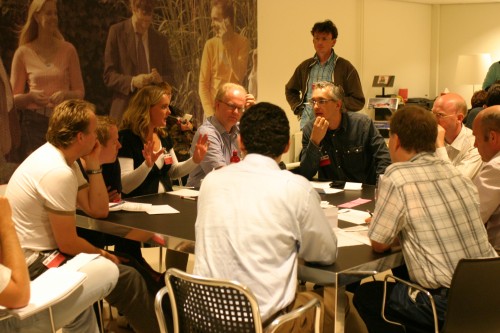
Jurgen Appelo writes in Communication = Information * Relationships that “top-down systems thinking is a management fad“. I agree. Systems thinking works only if it happens in all directions at once. It seems to work when a group of people is doing systems thinking in the same room at the same time. All combined, these people bring the perspectives that are necessary to come up with changes that work. Continue reading ‘Bottom Up Systems Thinking’
Tag Archive for 'people'
The new year seems to be an excellent time to think about your time management. It seemed to be for mine, and around new year I was chatting with Marc. Marc said “I’m reading a new book on personal productivity”. That made me think. Marc is one of the most productive people I know, so why would he bother reading yet another book like that. He has many, and I knew him since before he had any of those or was into, say methodology. Then, just like now, he is one of the most productive people I know.
“So, why bother?” I asked him.
“I’m productive, but I would like to do it with less stress”. I can understand that. And then I thought that by thinking about more productivity and less stress, you might achieve they opposite. I’ve met some very relaxed people. Were they thinking about stress? Probably not. Not thinking about stress may be like not thinking about a banana. You’ve probably read about research where they ask people to not think about something a banana, for instance, and it turns out they think more about it when you ask them not to…
Take Getting Things Done, for instance. The book has as subtitle “the art of stress-free productivity”. I have the book, and have tried it a couple of times. To me, it seems to have too many moving parts. Even if you take just one part, it might cause you stress. For instance, Johanna Rothman just wrote how Inbox zero is hard for her. GTD states that you should end every day with an empty inbox.
I tried that a couple of times, and after a while I could not get it to work either. In the mean time, I was stressing about it, worrying that I was not working to the norm I had set myself… Thus achieving the opposite of what I set out to do.
So, before Marc got around to explaining that The art of getting everything done by putting it off to tomorrow, and the main principles are of his shiny new tool, I came to the conclusion that it might be best for me to eat my own dogfood, and apply to myself what I tend to advise to teams these days:
Reflect, find out what works for you and do more of it (and do some experiments every once in a while to see if something else would work even better).
Trying out another methodology would not work for me at the moment, because, I might be worrying if I was ‘doing it right’. Asking if you’re doing it right is often the wrong questions to ask… And following a methodology to a T might give you more stress, and thus less productivity, instead of the other way around.
So don’t think about stress, I wish you a relaxed day!
I wrote a teaser post about iterative and incremental rebranding of eXperience Agile in September… It’s been four months and almost as many newsletters since then
. So time to de-tease the blog…
Marc suggested to do part of the upcoming newsletter as a Temperature Reading, so besides getting some information, our readers also learn a technique, and it helps us structuring our own reflection over the past year. It’s been about a year since Marc, Rob and yours truly sat together after xp days london to discuss closer collaboration with courses and coaching (but still as loosely coupled as possible, because we like our independence).
A Temperature Reading has five questions, the order of which you can vary, depending on the context (see Temperature Reading for explanation and the default order, I’m going to do something different here).
Continue reading ‘A QWAN year
’
Nicole Belilos and I are hosting a trial run of our ‘labour turnover – should I stay or should I go’ workshop – we’re going to also run it during agile2008. We’re doing a trial run next tuesday (June 17th) at the office of Topic in Best. contact me or Nicole if you want to join. If you want to know more, read the workshop description, or the full trial description in Dutch (below).
Continue reading ‘tryout labour turnover June 17th’
This was the only ‘red’ card in the retrospective we held today at the end of another eXperience Agile
Further there was one looking ahead (’Drink & book’ -meaning looking forward to drinks in the bar and receiving the book at the end of the course).
Personally I also loved ‘no more questions’ (I guess there will be more after a night of sleep). One thing we experimented with was shortening the iterations in Day 3’s exercises, so we would have time for a bit of questions and answers ‘open space’ style (or XP style – questions on post-its prioritized by the participants).
We had quite a number of ‘puzzles’ on Wednesday and Thursday, mainly open questions… And some red cards. Most related to traffic jams. Other cards we resolved quickly (not enough overview on the agend for the course – easily done with an extra flipchart, another one was that we had two pairs working off the same repository by accident, we still have some manual steps in installing workspaces that we do not yet know how to automate well due to the environment we are using. ).
Seeing the green cards, and the happy, exhausted faces, there probably was quite a bit of accelerated learning going on – and that is not a coincidence.
I ‘m especially pleased to see green cards where we used to have red and yellow – dilligent work, and keep on trying to improve a few things each and every course. I don’t know what we’re going to change in the next one (we have some ideas around acceptance testing and have been experimenting), but I’m sure we are going to change some things. We, the ‘instructors’ are also part of the learning community, and I strongly believe our own learnings accelerates that of the other participants.
Therefore we hold retrospectives after every course day. Sometimes in the afternoon, sometimes the next day. Where it makes sense we ’stop the production line’ and fix problems immediately, e.g. answer questions and gather questions for further discussion in a separate block or over lunch. In other courses this also helped us streamline exercises, the build environment etc.
As you might see in the green and yellow cards, much fun (green cards) and puzzles (yellow cards) come from the open source tools and games generously donated to the world. This includes the xp game, ruby, rspec, test/unit (included in ruby), firewatir, and of course techniques like XP, Refactoring and TDD that you can (amongst many sources) still read about on the C2 wiki and the XP mailinglist. And of course retrospectives.
I hope these happy colourful photos inspire you to experiment with retrospectives. A word of warning… besides focusing on what you can do better, don’t forget to celebrate the green cards (I have that tendency – still a bit of a perfectionist) and relax before the next round of improvments. Have a nice weekend
I’m still planning to procrastinating on writing more about cultural patterns. How better to procrastinate than with some light sunday reading:
“[...]a small startup, should be working twice as hard as the bigger companies [...]“
Taken from tales from the WTF company, part IIpart I
Excercise for the reader: which cultural pattern does the WTF company exhibit? You get bonus points for identifying coping stances from the story as well
).
Raphaël Pierquin just put the rough version of the agile open france proceedings online – to enable ‘us bloggers’ to start using the proceedings he uploaded scanned images with an index. A more polished version will follow later. This ‘reduce cycle time’ version already provides lots of value to me. For instance, I can now show you the beautiful notes Antoine Contal made of ‘Beyond Agile’:
Notes of Beyond Agile. Click the image for the full-size scan.
I decided to propose a run of “beyond agile”, so I could try a different way of presenting the cultural patterns before qcon London this wednesday. The runs at xp days last year (then dubbed ‘people vs process’) were well received, and gave us ideas for improvement:
- we needed the question and answer time to get across why we believe these patterns are useful in our work (they help us determine where we are, and decide on a strategy on where / how to go next),
- attendees got the idea that one goes from one pattern to the next in a linear fashion. We then presented it in a linear fashion then, so surprise,surprise…
In this instance, I ditched the slides and presented from flipchart. After presenting the ‘why’, the participants did a round of experiences on the questions:
- ‘did you ever experience people telling you that your mix of ‘agile’ practices is too much process? ‘
- ‘did you ever experience people telling you that your mix of ‘agile’ practices is too little process? ‘
We then gradually constructed the circle, starting with the cultural pattern (’routine’) suggested in the story told by the last participant. Meanwhile, I explained some common choreographies (the arrows), each with their advantages and difficulties through stories:
We discussed more choreographies than could sensibly make the notes, and further discussions over dinner gave me some more inspiration. Even this ‘circular’ drawing follows the same linearity as in Gerald Weinbergs’ books. In wednesdays’ presentation we’re also going to talk about some other choreographies (e.g. going from routine, or routine to oblivious).
As you might guess from the notes, we ran the entire session in french. I needed to ask for some words, and probably my grammar is not up to par, but overall it went much smoother than I expected. The other participants were extremely helpful in letting me and Barry Evans speak as much french as we could, providing us with words when needed, and allowing us to switch back to english when we couldn’t manage in french – less and less frequently needed as the days passed
.
So now it’s time to re-order the slides in a quasi-random order – some order that allows us to string stories together in a way that makes sense to the audience, add choreography slides and practice a bit more. I hope to see you at qcon on wednesday.
I went to Agile Open NorthWest last year, and it was a blast! This year’s announcement is eh, just-in-time, so I won’t be able to make it, but I strongly recommend it. Here is there announcement:
Agile Open Northwest, an alliance of agile practitioners in the US Pacific Northwest region, presents Agile Open Northwest 2008.
Our first agile open event, Agile Open Northwest 2007, was held last year and was a great success. This year, we once again invite 100 experienced, collaborative, committed agile practitioners from the Northwest and beyond to join us in tackling the issues around the theme of agile development in the real world.
The Northwest has a wealth of practitioners with years of real-world experience with agile methods and self-organizing teams. Agile Open Northwest offers an opportunity to strengthen our community of practice and co-create the future for agile development. Your commitment to arriving at the beginning and staying until the end both days will ensure we build on conversation after conversation as we engage important questions like:
- Who practices Agile in the Northwest and what is its impact?
- What is “Agile” anyway? What does it look like in organizations?
- What are the technical challenges facing Agile?
- How does Agile co-exist with project management, process control and other governance structures?
- Can we adapt agile practices to our organizations without diluting them?
- Can agile methods work in big, risky projects?
- Can distributed teams use agile approaches?
This event is designed to allow agile practitioners to meet in self-organizing groups where they can share their latest ideas, challenges, hopes, experiences and experiments. We follow an Open Space format to foster collaboration and allow the conference to take its direction from the participants themselves.
- What: An Open Space event discussing agile practices and techniques.
- Where: Seattle Center, in several of the Northwest Rooms.
- When: March 18 and 19, 2008
- Who: Anyone with some degree of experience in agile methods
- Cost: $100 per person, including lunch both days
Marc and I finished translating Belofte maakt schuld to English, we proudly present: Promise is Debt. In this case study, based on our own stories, we apply systems thinking to a common destructive behaviour pattern in IT organisations: overpromise when you underdeliver, and then overpromise some more…
So far we had a good response on Belofte maakt schuld, overpromising and underdelivering seems to be even more common than we thought.
Writing papers in two languages is an experiment for me, usually I write in English, and I used to write in Dutch when I was writing articles for Dutch IT magazines. Writing and editing a translation gives me a fresh perspective on the text, and in the meantime I’ve had some more discussions on the topic. In the end, I came to the conclusion that if you really want accurate estimates, and stop overpromising, you have to foster a culture where saying no is ok.
From the department of long-overdue-announcements
First off, the commercial service announcements. Marc Evers has joined the ranks of eXperience Agile facilitators. He is supporting Rob and me in getting a new Refactoring course off the ground. We plan to do trial runs in february (currently talking to a couple of places to do that, drop us a line if you are interested) and then the first public one, eXperience Refactoring, March 4 and 5, near Eindhoven.
Participants in other courses have long been asking us for a Refactoring course, a topic we mostly cover by showing and doing Test Driven Development, where Refactoring is a ‘natural’ step, so you don’t need to talk about it much. This one is going to cover refactoring in more challenging situations (e.g. when there is a bulk of legacy code – code without tests, or the team has been cutting corners for a while). This will prepare participants to stay vigilant in good times, and calm, resolved and focused in bad times…
We’re also planning to run another eXperience Agile near Eindhoven, 25 through 27 February
More new courses are in development for the second quarter. We’re listening to our customers, and would also love to hear from others what kind of courses they want.
Marc and I have been invited to present Beyond Agile at QCon London
People versus Process participants exercise at xp days london
I’m planning to attend Agile Open FranceHotel Arnold in Itterswiller, France (it is near Strasbourg, in the Elzas). Contrary to what I stated before, the dates are 5, 6 and 7 March.
To keep you up to date with upcoming courses and places I’ll be, I added two feeds to the sidebar: the
Public courses feed
Events I’ll be at feed


Recent Comments