Lasse Koskela looked at the Agile Open photos and asks me what the IDE in this photo is. Can you guess it?

I’m not sure I would call it an IDE (Integrated Development Environment), probably more a DIDE (DesIntegrated Development Environment), or DE (Development Environment), or, rather, just an editor.
When giving demos, or participating in collaborative coding events like a dojo, I prefer the environment and the programming language to be as simple as possible. This, to lower barriers to participation for everyone in the room, and since wall projections can carry less information, have as little screen clutter as possible.
So, this particular editor is simple, supports about 35 different programming languages and saves and runs the script, shown in the pane on the left, after pressing F5. The pane on the right shows the output. Both can independently be resized (ctrl+mousewheel).
(Spoiler, in case you haven’t guessed yet, the DE in question is SciTE. The testcase on the left is written in ruby, the simplest language you don’t know. SciTE is included in the most popular ruby installer for windows, and is included in most linux distributions ).
I managed to get the Agile Open photos online, a big thank you goes out to Marc Evers , who put my camera to good use. Having someone else take pictures as well freed me up to be more present during sessions. (draw parallells with pair programming).
Some photo’s to give a taste (there are many more photos from Agile Open than I can fit in a blog):

participants making the program

Coding Dojo (Randori)

break

break

Current reality trees don’t bite

round table discussion

Zen presentation

drawing carousel

drawing is released, even though it is not really finished…

thursday’s schedule

Friday’s schedule

Tom and Marc discussing

Bernard and Raphael discussing

xp game

waiting until the closing session wants to start.
I’m recovering from Agile Open, still feeling somewhat unconfenced / conferenced out
. I liked it a lot, biased as always, because I co-organize it… Unlike at some other conferences I visited recently, I was able to attend a couple of sessions I didn’t organize
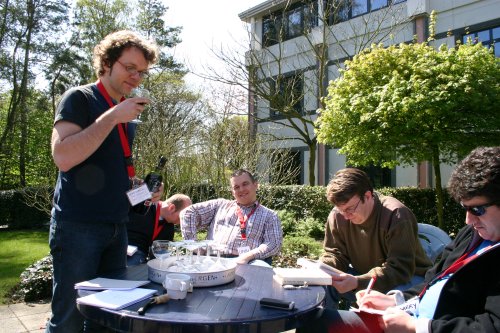
last and not least, the planned unprepared session, and after that the unscheduled unprepared session, outside on the terrace with wine and excellent conversation.

I believe we succeeded to strike a balance between structure and un-structure, keeping in mind the goal for this conference is openness, and maximum participation from everyone. On the second day we changed several things in the structure based on suggestions made during the opening that day. I had the feeling everyone was feeling more comfortable on the second day, because everyone knew each other a bit better. We may add some get-to-know-your-fellow-participants activity for a next event.
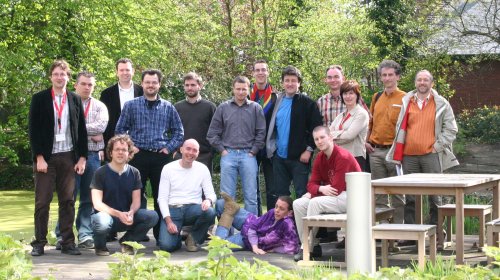
Raphaël suggested we make a group photo, so we can remember who’s who later. Unfortunately, when we got around to it, some people had already left. The mostly broad smiles say more than I could about this event. Wonder full:

I participated in (re)writing a bunch of discovery session and tutorial proposals for agile2006. That turned out to be interesting, as all but one of them got selected, amidst fairly stiff competition. We decided not to run the xp game – running too many sessions is bad for the quality of individual sessions, and there are similar sessions in the programme already.
As this conference is going to be large, we tried to let our sessions scale to larger audiences, amongst other things by having more co-hosts per session than normal. That leads to a web of sessions, where some sessions share almost the same set of hosts, but not quite. After acceptance, I had a hard time deciding how to give my best effort in running the sessions. I decided to take responsibility for running the sessions where I am first or second organizer, and support other sessions in a ‘best effort’ way, where I’ll do whatever I can based on time and energy that I have.
Participating in many proposals with many co-hosts is slightly confusing. But fun.
I’ll be co-hosting
- The drawing carousel – a pair programming eXperience
- Simple tools for communication – a Balancing Act
- Systemsthinking workshop – using the Diagram Of Effects (DOE) to effectively change your work environment.
Together with Marc Evers, hopefully supported by (in various configurations, depending on the session and what suits our co-hosts in the schedule) Laurent Bossavit, Emmanuel Gaillot, Rachel Davies and Lynne Azpeitia.
I’ll be supporting in preparation and/or running (tool words is in the same slot as systems thinking unfortunately):
- Tracer Bullets (an experiential session on feedback) by Rob Westgeest and Tjakko Kleinhuis
- Tool Words, Weapon Words by Laurent Bossavit and Emmanuel Gaillot
- Writing on the Walls (about the use of information radiators) by Laurent Bossavit and Emmanuel Gaillot
Writing on the Walls is new, Tracer Bullets revamped – I haven’t had the good fortune of attending it so far.
Recent Comments